
How to Build a Successful Content Marketing Program From Scratch

Nighthawk often inherits content programs that are messy, unclear, and disconnected from business goals. There is no editorial calendar. Content governance is vague. Different teams publish material that contradicts each other. And nobody can clearly explain what the content is supposed to accomplish.
At Nighthawk Digital Marketing, we see this all the time. Companies invest heavily in content but lack the strategic framework needed to turn it into visibility, authority, pipeline, and measurable growth. The good news is that this is not a failure. It is an opportunity. When you rebuild a content program the right way, you can dramatically improve brand credibility, search visibility, and lead generation.
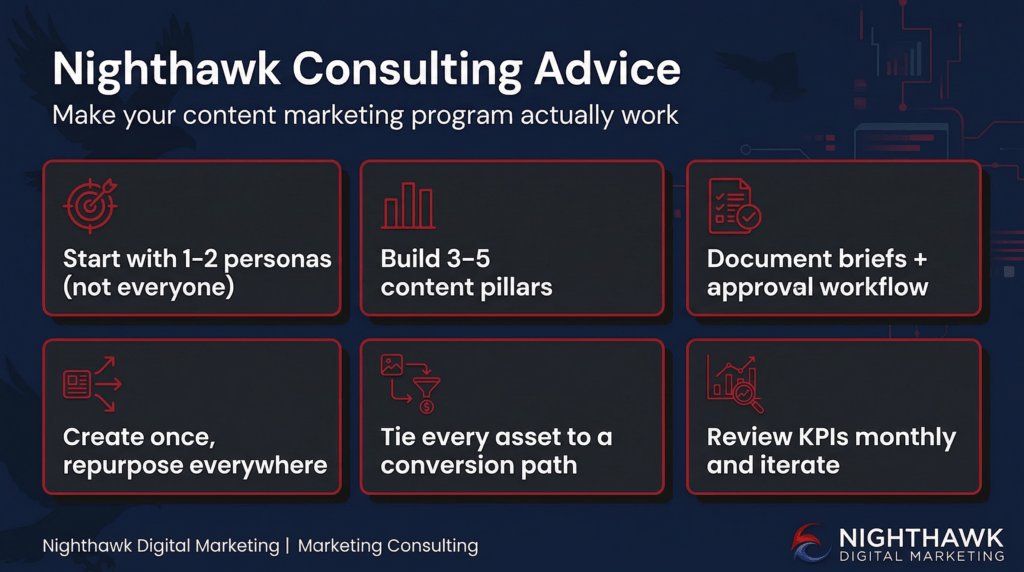
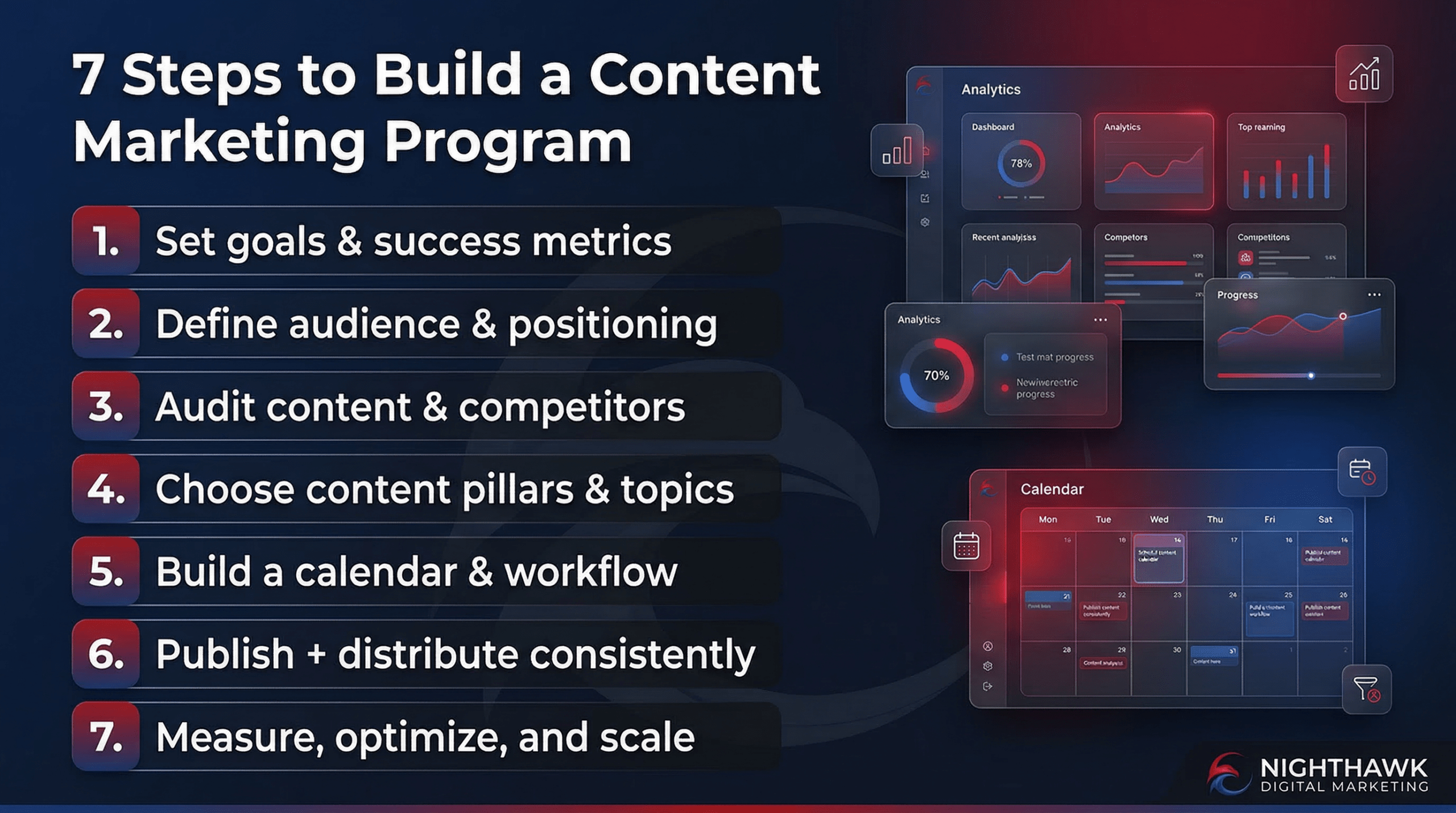
Here are the seven steps we recommend when launching or rebuilding a content marketing program from scratch.
1. Start by Listening Before You Change Anything
Most new marketing leaders want to fix everything immediately. That is usually a mistake. Before making changes, spend time understanding how the organization currently operates.
This is where the classic “As-Is / To-Be” model becomes extremely useful. Start by documenting the current reality:
- Interview sales leaders about what content actually helps close deals.
- Ask executives what they believe the brand represents.
- Audit all existing blog posts, whitepapers, videos, and landing pages.
- Identify which content generates traffic and which content nobody reads.
At Nighthawk, we often begin with a content audit and discovery workshop with leadership teams. It quickly reveals the biggest problem most companies face: most organizations produce content without any real understanding of who it is for or what it is supposed to accomplish.
“Most organizations produce content without any real understanding of who it is for or what it is supposed to accomplish.”
— Robert Bond, Founder, Nighthawk Digital Marketing
Once you understand the current environment, you can define the future vision. Stakeholder mapping tools like RACI charts are especially useful here for clarifying:
- Who owns content decisions
- Who contributes ideas
- Who reviews content
- Who has final approval
Without governance, content programs collapse quickly.
2. Understand the Company, Product, Market, and Audience
Content that performs well is grounded in business reality. Before building any content strategy, marketing leaders should deeply understand four things: the company, the product, the market, and the audience.
The Company
Document the company’s mission, vision, values, and positioning. A clear messaging document helps ensure that your content supports the broader brand narrative and stays aligned across channels.
The Product
Marketers must understand products the same way customers do. Explore use cases, competitive alternatives, pricing dynamics, and buyer objections. At Nighthawk, we often advise clients to mystery shop their own product experience. One of the best ways to do this is to start where a real prospect starts—through a Google or ChatGPT search—and then go through the website from that perspective.
It exposes gaps in messaging immediately.
The Market
Analyze competitors and category positioning. A simple SWOT analysis works well here. Understand where competitors dominate, where they are weak, what messaging they use, and what content performs well for them.
The Audience
Content without a defined audience is just noise. Create ideal customer profiles, buyer personas, and customer journey maps. These define what content to create, who it is for, and when it should be delivered.
“If your content does not clearly match a stage of the buyer journey, it is unlikely to drive revenue.”
— Robert Bond
3. Establish a Clear Brand Identity
One of the most common issues we encounter is the absence of brand guidelines. Without a brand framework, every team creates content differently.
Your brand guide should define:
- Corporate Messaging: mission, positioning, target audiences, and competitive narrative
- Editorial Standards: tone of voice, writing style, messaging themes, taglines, and positioning
- Visual Identity: logo usage, color palette, and imagery style
These guidelines ensure that content remains consistent regardless of who creates it. They also dramatically improve collaboration with agencies, freelancers, and internal teams.
At Nighthawk, we treat brand governance as non-negotiable. It does not have to be complicated, but without it, content programs eventually become chaotic.
4. Align Resources and Business Goals
Content marketing must support measurable outcomes. Unfortunately, many organizations produce content without connecting it to business metrics.
Start by defining success. This may include:
- Organic traffic growth
- Lead generation
- Sales enablement
- Brand authority
- Thought leadership
Then determine what resources exist to support those goals. This includes marketing team capacity, budget, tools and platforms, design resources, and subject-matter experts.
“A small team executing one excellent content program will outperform a large team attempting ten programs poorly.”
Focus creates results. In larger teams, people often step all over each other by creating disconnected messaging for events, product pages, landing pages, paid ads, PR, and more. Without alignment, the result is inconsistency across the brand.
5. Map Programs to Channels and Outcomes
Once the strategy is clear, map your marketing programs visually. This helps executives understand how marketing activity translates into business results.
Your framework should connect:
Program → Channel → Outcome
For example:
- Thought Leadership Program → Blog + LinkedIn + Newsletter → Brand authority and SEO growth
- Lead Generation Program → Webinars + Landing Pages + Paid Ads → Pipeline creation
Visual strategy maps dramatically improve organizational alignment and make it easier for leadership to understand the role of content marketing.
6. Build a Practical Content Calendar
A content roadmap transforms strategy into execution. This can be as simple as a spreadsheet. Many teams try to over-engineer project management tools when a basic system works perfectly well.
Typical content calendars track:
- Content format
- Campaign association
- Owner
- Due date
- Status
- Publishing channel
- Performance metrics
At Nighthawk, we often recommend starting with a quarterly roadmap and then refining it into weekly deliverables. Consistency matters more than complexity.
7. Design the Operational Workflow
Finally, define how your content program operates day-to-day. A strong workflow prevents bottlenecks and helps great ideas turn into published content efficiently.
Idea Generation
Establish a formal system for collecting content ideas. Many organizations use an idea submission form so sales teams and executives can contribute ideas strategically.
Content Review
Define who reviews drafts, when design becomes involved, and what approval timelines look like. Clear workflows reduce confusion and keep projects moving.
Content Distribution
Even great content fails without promotion. Define how content will be shared across social media, newsletters, sales enablement platforms, and internal communication channels.
Content Maintenance
Content requires ongoing management. Establish a review cycle to update outdated messaging, fix broken links, and identify SEO opportunities over time.
Bringing Your Content Program to Life
There is no universal blueprint for content marketing success. Every organization operates differently. However, successful content programs usually share three traits:
- Strategic alignment with business goals
- Clear governance and workflow
- Consistent execution
At Nighthawk Digital Marketing, we help organizations rebuild and scale content programs that generate measurable business impact.
“The difference between content that gets ignored and content that generates leads is strategy. Once the framework is right, the results follow.”
— Robert Bond
Call to Action
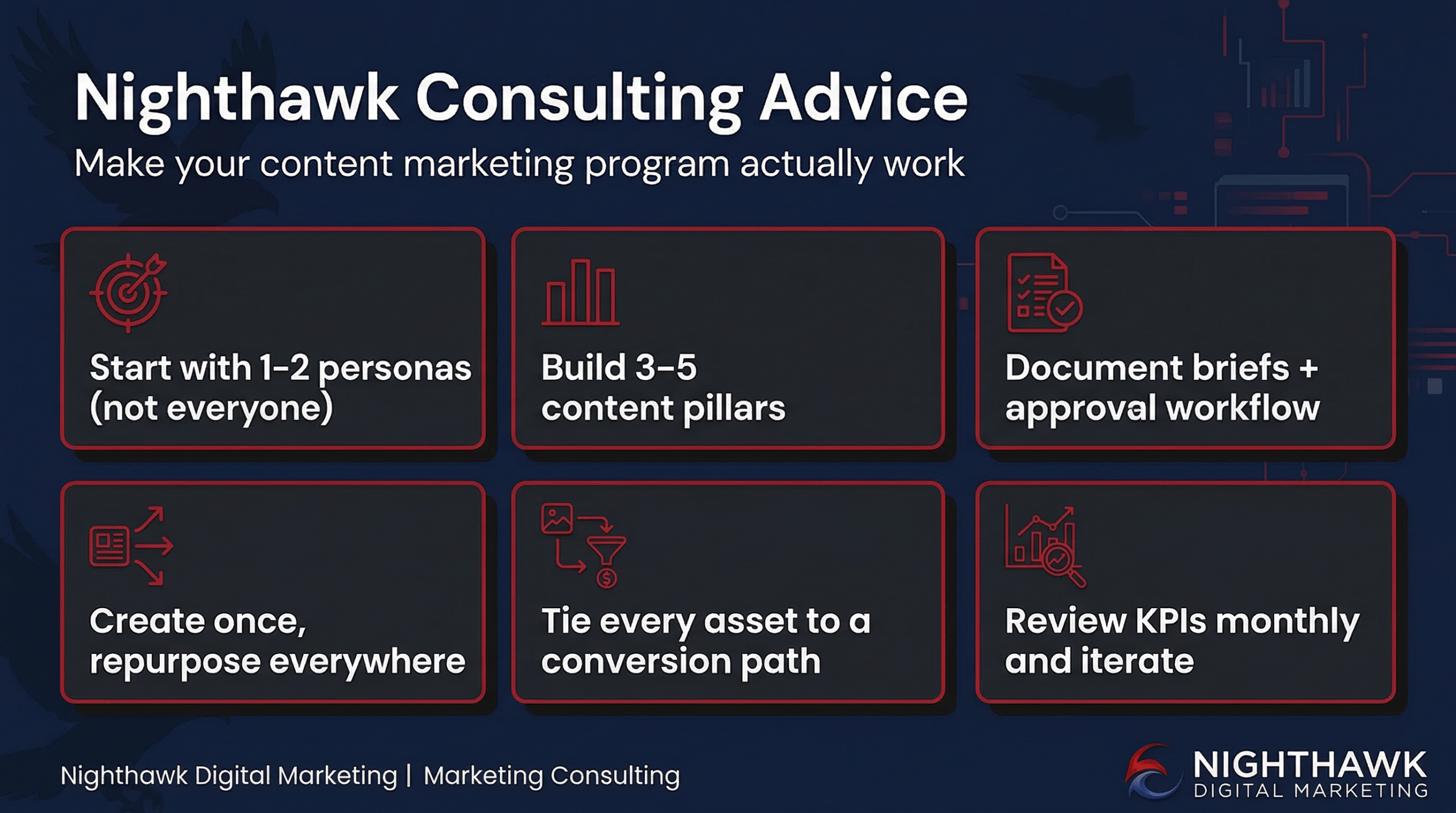
If your content program is not producing leads, traffic, or authority, it may be time for a strategic reset. Nighthawk Digital Marketing helps companies design and execute modern content strategies that drive real business outcomes.
Contact us today for a marketing strategy consultation.